In the long run Turkey is still an attractive market, despite current unrest
If the unrest continues, the country could face credit risks
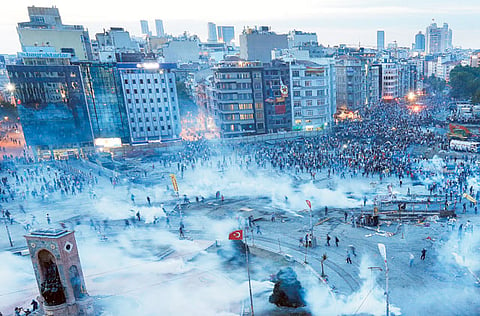
Anti-government demonstrations at Istanbul’s Taksim Square continued on Thursday even after Prime Minister Recep Tayyip Erdogan asked the police to clear the park of “troublemakers” after his ruling Justice and Development Party proposed a referendum on the proposed development that was the trigger for the protests.
In the past month, since the protests began, the Istanbul stock market has slumped about 10 per cent and the Turkish currency lira had dropped to an 18-month low before the Central Bank last week took steps to stabilise the currency. New reports have suggested that foreign direct investment that financed a large portion of the current account deficit have declined after the demonstrations began. Tourists are staying away too. All these does not augur well for the businesses, economy and the market. The ratings agencies Moody’s and Fitch, which had upgraded Turkey to investment grade, have said that if the unrest continues, the country could face credit risks that could pressure the ratings.
The government’s offer of referendum was the first sign since these events started that showed that the government could make a concession and therefore created some cautious optimism, said Eli Koen, who manages a $140 million Turkish fund for Swiss bank Union Bancaire Privee.
“However, any intervention to Gezi Park could lead to an escalation of the situation,” Koen said. “As I write this [on Thursday], the situation is calm but I believe it remains highly unpredictable and potentially volatile.”
In the long term, the cautious fund manager sees this whole event as part of the birth of a true pluralist democracy in Turkey and believes this is good news for the economy and markets.
Talking about the stock market, which has seen an outflow of around $8 billion in the last one month, including the outflows that started with the US Federal Reserve tapering and accelerated after the events, Koen said that in the short term, the birth pains of this would likely continue to create volatility.
“I think as the frequency of protests rise and the violence levels drop, the markets will get more and more used to them and react less,” he added. “It is of course impossible to have a short term, day by day road map of how events will unfold and how/when we will get to that point, but I believe this is the direction things are moving towards.”
Since its inception in April 2010 until the start of the protests in mid-May, Koen’s UBAM Turkish Equities Fund returned close to 43 per cent ( in US dollar terms after fees) as against the benchmark MSCI Turkey 10/40’s return of 29.4 per cent. But in the one month of protests Koen’s fund has lost about 21 per cent of that three-year cumulative gain.
“Among the international Turkish funds, it has been the best performing during that three-year period,” said Koen during his visit to Dubai last week. “But we always said from the very beginning that Turkey is a very volatile market — those investing in it should be taking a minimum of a three-year view. And what’s happening at the moment goes along with that view.”
Year to date the stock market index is flat. This stands in sharp contrast to last year’s spectacular 53 per cent surge.
If there’s one good thing about the protests from an investment point of view, the market has moved to an attractive valuation level. A seven-year historic median price to earnings ratio for Turkey stands at 11 times.
“Around mid-May it was closer to 13 times — it was getting to what I would consider in the expensive range,” said Koen. “Today it is almost exactly at the historic average.”
On a company specific level, looking at especially the small and mid cap segments of the market, which have been more affected from this latest fall, he said one can now really find cheap stocks.
“Cheap for me being defined as stocks that have 30 to 35 per cent upside to what I would consider fair value,” Koen said.
With regard to sector allocation in his fund, about 40 per cent to 45 per cent of the fund consists of financials. “With interest rates coming down and with the economy normalising, proper banking has started in Turkey,” he said. “There’s a huge potential for the banks to sell mortgage and insurance products, to introduce savings instruments, [go for] corporate lending, SME lending — this is all just starting in Turkey. We think there’s a very big potential for banks, especially those who have a good national distribution and good IT infrastructure. There are quite a few banks that fit into these criteria.”
Other sectors that he believes are attractive include construction, construction material such as like cement, glass and steel, infrastructure, consumer durables and retail chains.
“The nice thing about the Turkish stock market is it is well diversified,” he added. “Depending on where you are in the cycle, you can pick stocks.”


