Middle East leads rest of the world in demand for 3D TV
UAE in 10th spot among 52 countries in Nielsen Report
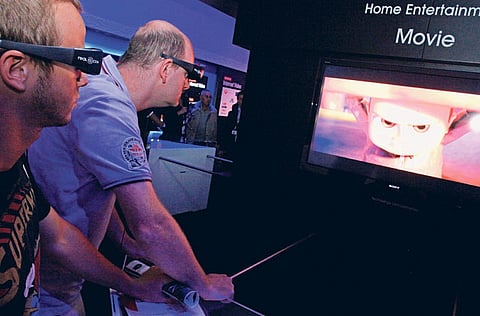
Dubai: With 3D cinemas gaining widespread popularity in Middle East entertainment, more consumers are choosing to take the experience to the living room.
The Middle East has more than doubled the interest and ownership of 3D-TVs than anywhere else in the world according to a recent consumer report released by Nielsen.
The UAE came in at 10th place out of 52 countries with Saudi Arabiaon top.
"Once again we see that the Middle East has enormous investment potential for the consumer and entertainment market. Young Arab professionals in particular are extremely keen to be a part of the latest technology, the most sophisticated equipment and at the forefront of the technology adoption landscape," said Trixee Loh, organiser of the upcoming Gitex event.
3D-TV currently has a niche global audience.
The report estimates that 12 per cent of global online consumers own or have definite intent to purchase a 3D-TV next year.
This is small when compared to the 30 per cent who own or are looking to purchase High-Definition TV (HDTV) and approximately 70 per cent of consumers that utilize online television.
"The HDTV has helped to keep the living room relevant as new screens proliferated. To a much more limited extent, 3D-TV may have the same effect: trumping the experience of smaller, more portable screens and providing an unrivaled video viewing experience," stated the report.
The unveiling of the 3D- TV in the UAE came out in time for the World Cup with many major electronics outlets reporting an increase in demand for 3D-TV's for the summer and World Cup season.
Niche product
However, while there was an initial spike in sales, many major retailers still report it being a niche product.
"The 3D-TV hasn't really kicked off or made a big impact on the market here as we understand. At the moment sales across our stores have been slow and we've been selling in single digits. The main reason is that 3D content is not available in big quantities through DVDs. broadcasting, etc. and until the software is available there is no point in spending a lot of money to buy the TV. Once the mass production starts and the pricing of the TV starts to come down a bit we can expect the technology to become more popular," Neelesh Bhatnagar, CEO of Emax told Gulf News.
Rakesh Khanna, head of Sony division at Jumbo Electronics said that LCD and LED TV's are still major drivers of the sales.
"Currently there is limited content available however product is looked upon as future-proof technology. In the case of local Arabs, a desire to own the latest products is an important driver of sale," said Khanna.
Around 20 movies are to be made in 3D this year, with a more expected to be released in 3D form on blue-ray discs including the 25 Fifa World Cup 2010 games in South Africa.
The highest 3D ownership or definite interest in ownership was among 25-29 year olds.
According to iSuppli, a leading technology market research company, global 3D-TV shipments are expected to reach 4.2 million units by the end of this year. This number is expected to triple to 12.9 million units in 2011 and then more than double to 27.4 million units in 2012.
Sony expects that 3D televisions will make up more than 10 per cent of all sets it sells in the financial year that begins in April 2011 from 5 per cent this year.
"We expect to earn $10 billion from 3D-related products in 2012," said Hiroyasu Sugiyama, general manager, global sales and marketing Group, Sony Corp, in a previous interview with Gulf News.
Panasonic is also predicting rising sales.
"Over the last month Panasonic conducted market research and monitoring has seen the demand for Panasonic 3D televisions increasing by 510 per cent. We see demand growing significantly for 3D products and technologies," said Shimpei Tsujigami, senior product manager at Panasonic Marketing, Middle East
Currently Panasonic offers one model in the region and is looking to launch two new models — with a screen size of 65 inches and 42 inches — within six months.
Would you buy a 3D TV? Or do you prefer traditional modes of viewing visual content? Would new ways of watching television help bring back viewers who usually stream videos on the internet?

