Knock-off stores are the new wave of piracy
China's knock-off stores replicate look, feel and service of big retail concepts
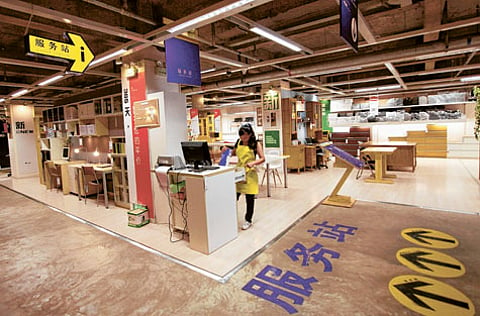
Kunming, China: Nestled in a sleepy southern district of Kunming city in southwest China is a 10,000 square metre, four-storey building that could make Swedish furniture giant Ikea uneasy.
11 Furniture, as the store is known, copies Ikea's blue and yellow colour scheme, mock-up rooms, miniature pencils, signage and even its rocking chair designs. Its cafeteria-style restaurant, complete with minimalist wooden tables, has a familiar look, although the menu features Chinese-style braised minced pork and eggs instead of Ikea's Swedish meatballs and salmon.
This knock-off Ikea store is emblematic of a new wave of piracy sweeping through China. Increasingly sophisticated counterfeiters no longer just pump out fake luxury handbags, DVDs and sports shoes but replicate the look, feel and service of successful western retail concepts — in essence, pirating the entire brand experience.
"This is a new phenomenon," said Adam Xu, retail analyst with Booz&Co. "Typically there are a lot of fake products, now we see more fakes in the service aspect in terms of [faking] the retail formats."
Brands are much more than a logo on a handbag or some half-eaten pipfruit on a computer.
Many of the most successful consumer companies have invested millions in promoting and building brands which encapsulate ideals, values and aspirations, creating valuable and loyal customer bases that sometimes border on cults.
Last month, an American blogger set off a media storm after she posted pictures of an elaborate fake Apple Store in Kunming, selling genuine if unauthorized iPhones, Macbooks and other widely popular Apple products.
The presence of the fake stores in Kunming highlights China's seemingly insatiable appetite for western brands in some consumer segments that have not been tapped, particularly in smaller cities far from the affluent eastern seaboard.
"What these fake stores indicate is that there is demand for the types of products and concepts that these brands sell," said Hong Kong-based Torsten Stocker, a China retail analyst with Monitor Group.
The problem for companies that have been faked is that even if the fake stores sell genuine products, the brands have no control over how customers experience their brands.
Zhang Yunping, 22, a customer service representative at 11 Furniture, is used to the questions about Ikea. "If two people are wearing the same clothes, you are bound to say that one copied the other," Zhang said, shrugging her shoulders.
"Customers have told me we look like Ikea. But for me that's not my problem. I just look after customers' welfare. Things like copyrights, that is for the big bosses to manage," she said.
11 Furniture's owner could not be reached for comment.
Ikea said it has teams working at both the country and global level to handle intellectual property protection issues.
"Ikea as one of the biggest home furnishing companies in the world, protecting Ikea's intellectual property rights is crucial," Ikea China said in a statement to Reuters.
Ikea has nine stores in China. Xiao Lee, a Kunming resident who was shopping at 11 Furniture for a bedroom wardrobe with her husband, had visited Ikea stores in Beijing and Shanghai.
"I thought of shipping their products from the real Ikea store by cargo, but I thought that would be too troublesome so I came here," Lee said.
"At the real Ikea, the layout is much neater and the decorations are laid out properly, you really can't compare them," she said.
Beijing (Reuters) Sometimes telling the difference between fake and real is not so easy.
"My favourite character is Mickey Mouse," said Ling Xiao, a six-year-old girl walking out of a Disney Store along Kunming's popular pedestrian-only shopping street Zhengyi Road.
Apart from Disney products, the store sells poorly made Angry Bird soft toys of dubious origin. A Walt Disney spokeswoman said there are over 6,000 points of sale for Disney branded goods in China. Disney confirmed the store is legitimate, declining to elaborate further.
Outside a Nike store on the same retail strip, Han Zhimei, a 17-year-old student, looks longingly at a ‘Help Wanted' sign posted in the store's window.
"I feel their stores have a spirit of teamwork and I really like the Nike brand," said Han, who sports a trendy asymmetrical haircut. Han stopped by to apply for a job at Nike.
When asked how she knows the store is a legitimate reseller and that the goods are real, she pauses before answering.
"Well, it's a Nike store, so the things in there should be real. I think people will be honest about these things and we should have brand loyalty," Han said.
Mad jumble
On Zhengyi Road alone, there are four Nike stores, all claiming to be legitimate. A check with Nike's store locator brought up three stores in that street, meaning at least one is fake.
The jumble of real and fake stores in lower tier cities across China makes it hard for companies such as Apple, Disney, Nike and more so Ikea, which are closely identified with their outlets, to exert control over their brand image.
Companies such as Starbucks have long battled copycats in China, but the shift to imitations of the likes of Ikea presents new challenges.

