Dragon's commercial success opens new frontier
It marked the first time a business enterprise delivered a supply ship to the space station
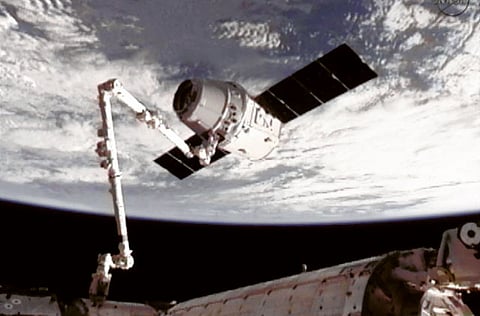
Cape Canaveral, Florida: The private company SpaceX made history on Friday with the docking of its Dragon capsule to the International Space Station, the most impressive feat yet in turning routine space flight over to the commercial sector.
It marked the first time a business enterprise delivered a supply ship to the space station.
"There's so much that could have gone wrong and it went right," said an elated Elon Musk, the young, driven billionaire behind SpaceX.
"This really is, I think, going to be recognised as a significantly historical step forward in space travel — and hopefully the first of many to come."
Next venture
SpaceX still has to get its Dragon back this week with a load of science gear. The retro bell-shaped capsule is designed to splash down into the ocean, in the style of the Mercury, Gemini and Apollo programmes. But Friday was the crucial step, Musk noted, and Nasa agreed the next SpaceX mission could come as early as September.
After a three-day flight from Cape Canaveral, the Dragon closed in on the space station as two control centres — Nasa in Houston and SpaceX in Hawthorne, California — worked in tandem. A problem with the capsule laser-tracking system prompted SpaceX controllers to order a temporary retreat, but the problem quickly was resolved.
The company's youthful-looking employees — the average age is 30 — were still in a frenzy when Musk took part in a televised news conference a couple hours later. They screamed with excitement as if it were a pep rally and chanted, "E-lon, E-lon, E-lon," as the 40-year-old Musk, wearing a black athletic jacket with the SpaceX logo, described the day's events.
Although cargo hauls have become routine, Friday's link-up was significant in that an individual company pulled it off. That chore was previously reserved for a small, elite group of government agencies.
Not only that, the reusable SpaceX Dragon is designed to safely return items, a huge benefit that disappeared with Nasa's space shuttles. It is the first US craft to visit the station since the final shuttle flight last summer.
Nasa provided seed money for SpaceX — $381 million (Dh1.39 billion) going into Tuesday's launch, a small portion of the more than $1 billion that the company has invested in the effort.
After this test flight, SpaceX — officially known as Space Exploration Technologies — has a contract to make a dozen delivery runs. It is one of several companies vying for Nasa's cargo business and a chance to launch Americans from US soil.
Rival effort
Rival Orbital Sciences is shooting for its own supply run by year's end.
US President Barack Obama is pushing commercial ventures in orbit so Nasa can concentrate on grander destinations like asteroids and Mars. Obama's chief scientific adviser, John Holdren, called Friday's link-up "an achievement of historic scientific and technological significance".
"It's essential we maintain such competition and fully support this burgeoning and capable industry to get US astronauts back on American launch vehicles as soon as possible," Holdren said in a statement.
Without the shuttle, Nasa astronauts must go through Russia, an expensive and embarrassing situation for the US after a half-century of orbital self-sufficiency. Once companies master supply runs, they hope to tackle astronaut ferry runs.
Musk, who founded SpaceX a decade ago and helped create PayPal, said he can have astronauts riding his Dragon capsules to orbit in three or four years. He also runs the electric car company Tesla Motors.
The space station has been relying on Russian, Japanese and European cargo ships for supplies ever since the shuttles retired. None of those, however, can bring anything of value back. They're simply loaded with trash and burn up in the atmosphere.
Return mission
The space station's six-man crew will release the Dragon on Thursday after filling it with science experiments and equipment. It will aim for the Pacific Ocean just off California.
"At the beginning of the launch, I said there were a thousand things that had to go right," said Alan Lindenmoyer, manager of Nasa's commercial crew and cargo programme. "Well, there still are several hundred left. But I am very confident we'll get through it. ... Today this really is the beginning of a new era in commercial spaceflight."

