World Cup stadiums seek standing ovation
Brazilian cities selected to host the world's most awaited football matches are buzzing with activity as construction of new playing fields gathers steam
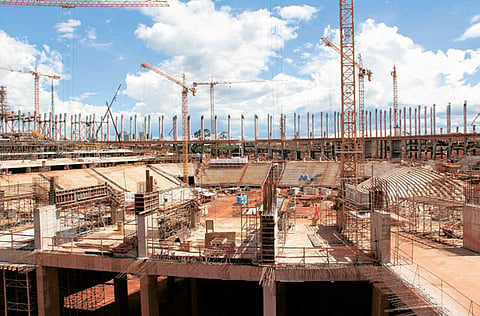
Itaquera, one of the poorest neighbourhoods in Sao Paulo, has a lot to cheer about ahead of the 2014 Fifa World Cup in Brazil.
The sheltering arms of giant cranes cradle the area's ticket to booming business: the site of the Arena de Sao Paulo, where the opening match of the World Cup will be played and the stadium will become the home of the city's most popular club, Corinthians Paulista.
The Fifa World Cup is forecast to bring $28.5 billion (Dh104 billion) in direct economic benefits to Brazil between 2010 and 2019 through investments in infrastructure, incremental spending by tourists and an increase in household consumption, according to government statistics. Indirect benefits add an estimated $81.4 billion.
The total benefits in those nine years will be equivalent to a 0.4 per cent annual average increase in the country's GDP.
Itaquera means "sleeping stone" in the Tupi-Guarani dialect, but this neighbourhood, like many of the games' host cities, is waking up to buzzing development activity.
The Itaquera stadium is expected to boost employment and government investments in the Eastern Zone, Sao Paulo's poorest area and home to nearly four million people.
Nearly 6,000 people will be employed directly and indirectly during construction, according to the Fifa World Cup website.
A quarter of the 68,000-seat stadium has been constructed to date and full completion is scheduled for December 2013, Felipe Morais Pacifico, Civil Engineer at the Construction Unit of construction company Odebrecht, told Gulf News during a visit to the site.
On schedule
Unlike other stadiums facing delays due to funding or strikes, the Itaquera stadium is on schedule, he said.
The stadium is a private project owned by Brazilian football club Sport Club Corinthians Paulista or the Corinthians and built on their land. The club will take loans from the Brazilian Development Bank (BNDES) to fund the 820 million reais (Dh1.7 billion) stadium, Pacifico said.
The project qualifies for a 60 per cent tax credit, or 400 million reais in this case, as this mega-project is built in the city's poorest zone.
The Corinthians, the only one of the three biggest teams in Sao Paulo that did not have its own stadium, negotiated a contract with Odebrecht to build the stadium.
The stadium's original capacity is 48,000 seats, but another 20,000 temporary seats will be added for the World Cup. The opening match, the semi-finals and four other matches will be played in the stadium.
Asked about any community or facilities displaced by the construction, Pacificio said that a youth training centre and three soccer fields had to go.
Odebrecht is also building stadiums in Rio de Janeiro, Salvador and Recife, Pacifico added.
The Itaquera stadium alone employs 1,200 people at present and will increase to 2,000 during peak construction time, he said. They are working three shifts in 22 hours to ensure that the project gets completed on time.
Odebrecht is training locals previously enrolled on social benefits as demand for construction workers increased dramatically with the number of infrastructure projects in Brazil ahead of the games.
Tourism catalyst
Real estate value around the stadium is expected to shoot up at least 30 per cent, the government is investing in roads and metro stations and tourism infrastructure will crop up, he added.
"The community comes here to visit, it is happy that this is happening in the neighbourhood," he said.
The event will catalyse tourism and development in this little neighbourhood, bringing with it the hotels and shopping malls. "It will really change this part of the city."
Environmental impact
In Brasilia, the country's capital renowned for impressive modern architecture, the Mane Garrincha National Soccer stadium is seeking to win LEED (Leadership in Energy and Environmental Design) platinum certificate from the US for its green construction.
Rigorous compliance with green building standards may initially raise building costs by five per cent, but could ultimately achieve operating savings of 7 million reais, said Vicente Castro Mello, associate of Castro Mello Arquitetos, responsible for the project of the federal capital's new arena.
The stadium construction is on schedule and completion is expected next December, Sergio Graça, Co-ordinator of the Brazil 2014 Committee, told Gulf News.
The 800 million reais stadium is funded entirely by the local government through the sale of land, an asset available in this comparatively new city, he said. This is pushing its progress ahead of other stadiums in Brazil that started from scratch.
There is less emphasis on the return on investments than on leaving a lasting legacy by the government for the people, he added.
"The government doesn't do this kind of maths… by the end of the year there will be an international bid for the management of the stadium. The managers can secure big events in the stadium not just for soccer, but as an open arena for concerts and different games. It will generate jobs and bring people to the city," said Graça.
The 70,000 seat stadium is being built after demolishing the former former Mané Garrincha stadium.
So far, about 30,000 seats have been built and the second of three levels is under construction including the VIP area.
It will witness the opening game of the Confederation Cup in 2013 and seven World Cup games.
"Brasilia is the youngest city and this will speed up the process of showcasing it," Graça said.
The stadium is located in the centre of the city and will adapt its existing roads to create an underground tunnel from the stadium to nearby sites like the Convention Centre and park located in the two million square metre sports complex.
The project's nickname is "you can" and given the quick-paced stadium construction and related development in Brasilia and Sao Paulo, it appears that they have a chance to make that final leap in time for the World Cup.

