A blood-soaked Bangladesh garments industry
Human tragedy of Rana Plaza gives the Dh2.1 trillion global apparel industry a costly wake-up call
Dubai: Golam Mostafa sits on a heavy revolving chair surrounded by a huge secretariat table which remains largely empty, except for a few newspapers, magazines, a few books and sometimes files – at his office in Banani – the upmarket residential and commercial neighbourhood of Dhaka, capital of Bangladesh.
His office is covered with concrete walls from two sides and the rest with glass overlooking an empty space, yet to be developed as a park – on the one side and Kamal Attaturk Avenue, the thriving commercial area on the other side.
Dhaka’s twin districts of Gulshan-Banani have the highest concentration of billionaires of Bangladesh – one of the poorest countries on earth. Golam Mostafa is one of them. Unlike many fellow businessmen, he is well educated, cultured, modern in outlook and uses technology to empower people and businesses. He is one businessman who still finds time to read. He is also a nationalist – tries to serve social causes and extends social benefits to people through his businesses.
The entire office building in the otherwise residential neighbourhood belongs to his Deshbondhu Group – a Tk16 billion ($200 million) annual turnover conglomerate – whose diversified portfolio includes a sugar refinery, a cement factory, a polymer industry, real estate, retail, commodities, trading and shipping.
Readymade Garments (RMG) – an industry that had created a new wealthy class in Dhaka and changed the fate of many of his friends – was not his cup of tea. However, it changed later.
So when he came to know that a sweater factory in Dhaka had closed down due to financial difficulties, he rushed to its rescue. He eventually bought the sick factory in 2004 and revived it under the name Southeast Sweaters.
“I did not have any plans to enter this business as my plate was already full. However, I saw an opportunity to help some people get jobs by reviving it,” Mostafa, who has invested in setting up his group’s overseas office in Dubai, quips. “I now have three sweater factories that employs 1,200 people – of which 850 are from the rural area of Kurigram district – the place where I come from. It was more out of social responsibility – providing employment to poor workers, especially the womenfolk – that I had entered into this business.”
Proceeds from sweater exports represent just 5 per cent of his group’s annual turnover generated by a workforce of 5,000 people.
The health, safety and working conditions at his factories – and many others – is in total contrast to those garments factories that have been hitting the global news headlines in recent weeks, including those located on the collapsed Rana Plaza in Savar, 30 kilometres away from Dhaka.
“There are good numbers of garments factories in Bangladesh which complies with the international set of standards,” Sabur Khan, President of Dhaka Chamber of Commerce and Industry (DCCI), told Gulf News. “Except few like Rana Plaza affects badly the image of Bangladesh garments sector. Very recently Chinese apparel sector entrepreneurs expressed interest to invest in Bangladesh as they found many factories here adequately compliant. If we can change the scenario by providing full support to the RMG sector then things will be changed rapidly.”
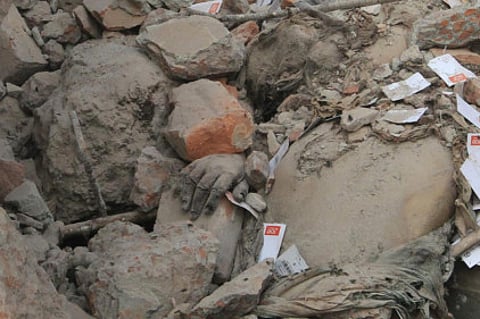
More than 4,000 workers were pushed to work and possibly to death in a faulty eight-storeyed building that housed a handful garments factories – on April 24, a day after one of its concrete pillars broke exposing the structure to cracks. Rana Plaza, named after a local youth leader who owns it – also housed the branch of a bank. The bank manager had asked his colleagues not to report for work on the fateful day, thus saving their lives. The poor garments workers were not that fortunate.
The human tragedy that has been unfolding since the collapse of Rana Plaza that has so far cost the lives of 1,100 poor garment workers – gives the $578 billion (Dh2.1 trillion) global apparel industry a costly wake-up call.
Such a high casualty is unheard of in a building collapse or industrial accidents, neither even in modern-day earthquakes – except maybe at a war. However, it happened in Dhaka when the building caved in – in just a matter of hours.
Although the cause of the collapse was due to construction defect, and perhaps corruption – in getting it approved, the garments industry fraternity will have to take responsibility for pushing the workers to death even after evacuating them from the same premises the previous day.
Whether this wake-up call translates to a worldwide shake-up for increased industrial safety, better wages and improved health and working condition, is to be seen in the coming years. However, this tragedy has brought some shocking realities to the fore, which will take a lot of time to fade from public memory.
First, the quest to make cheap clothes for Western consumers has created a global supply chain that could only survive by cutting costs – and thus trying to find cheaper sources in the East.
Secondly, this has resulted in a systematic exploitation of workers who are deprived of their due and rightful minimum wages. A worker gets Tk3,000 ($35) per month – price of a shirt.
Thirdly, due to the pressure of reducing costs in order to supply cheaper clothes, the RMG factory owners had to continuously find cheaper means to make them. The only way one could do that is through short cut – by compromising on wage, health and safety conditions – that is the root cause of all these incidents.
Fourthly, due to the above factors, this industry had to bank on modern-day slavery where labour exploitation is in direct proportion to profitability. This is an industry that tried to match cheapest price of products by killing workers.
And lastly, in the age of globalisation, this slavery has become more organised and globalised than anytime before.
The collapse of Rana Plaza reflects the worst form of neglect of human lives by a global industry that thrived on slavery and makes a mockery of the civilisation that stands on certain fundaments such as labour laws and human rights.
The workers’ lives have systematically been short-changed for profits. Some of the garments factories have become death traps – where workers are allowed to die – either by fires, building collapses or other man-made disasters – to ensure that consumers could buy clothes at a cheaper price.
“The shirt we export at a price of $5, is sold in the wholesale market at around $15. By the time it reaches the retail outlet, it is priced at anywhere between $25 and $30 even more depending on the brand,” Mostafa says. “So, we, at the source market, do not make much. We are selling it cheap, that’s why the orders are coming to us.
“However, the profits are being made at the other end.”
Despite this harsh reality, it is an industry that has created hundreds of billionaires and scores of them have become members of parliament while some of them held cabinet posts in the country.
One thing, however, did not change – the fate of the garments workers – who continue to struggle to make both ends meet every day.
The minimum wage of a female garment worker is fixed at Tk3,000 ($35-$40 depending on the exchange rate) a month – which is too little for a family.
Mostafa says, the workers’ minimum earning averages between Tk5,000 to Tk6,000 a month due to overtime and other benefits. “The male workers earn more due to the nature of their work,” he says. “At our factory, for example, the basic minimum wage is Tk4,000 and each female workers take home at least Tk6,000.”
This is still not enough, he admits. “They should be better paid. However, the most important aspect is the occupational health and safety and the working condition at the factory – these needed to be improved a lot,” he says. “The problem lies in compliance, or the lack of it. The government should implement strict and rigorous checks of the facilities and see if they are suitable for running garments factory.”
Readymade garments industry represents 13 per cent of Bangladesh’s gross domestic product, 80 per cent of its export earnings, fetching the South Asian country about $20 billion foreign exchange. More than four million workers, mostly women – work in 5,000 garments factories spread across the country.
It is an industry that mostly employ women - has changed the gender equation in a male-dominated society where women often used to be at the receiving end. This industry has given women much voice in their household in a country where women have been running the government for more than two decades. Economic empowerment has given them a stronger voice in the family as Bangladeshi society has been witnessing a silent revolution of some sort over the last quarter of a century.
“The garments industry has literally changed the social landscape where women are gaining power in society,” Mostafa says. “While women leadership is providing the necessary facilities and support for women empowerment from the top, the women professionals, workers and businesswomen are also coming forward to take full advantage of this.”
Mostafa said, the empowerment of women is helping reduce the influence of religious elements in society.
Most of the garments factories in Bangladesh are located in Dhaka and have been set up in hurriedly built concrete structure, most of them fails to meet the minimum safety standards.
“Safety must be given the highest consideration by the Government, employers and workers in Bangladesh. Those responsible for the tragic events that have occurred in Bangladesh over the past six months shall be held accountable,” the International Labour Organisation (ILO) said in a statement on May 4, after its team had met with Bangladesh government officials, representatives of the garment industry – the owners and workers.
“Unless lawful actions are taken at the earliest more lives may be lost in preventable industrial accidents. The tripartite partners therefore resolved to increase their efforts to provide every single worker in Bangladesh with a safe work place, and to ensure workers’ rights and representation, regardless of whether that work place may be a garment factory, a retail shop or a bank,” the statement said.
With 12 per cent average annual growth rates, clothing exports are the key driving force behind GDP growth (7 per cent compound annual growth rate from 1995 to 2010).
As a developing country, Bangladesh is under close scrutiny by nongovernmental organizations (NGOs) and corporate social responsibility (CSR) stakeholders regarding compliance.
Both CSR experts and buyers report improved labour and social compliance standards, but there is still a broad range of compliance seen across suppliers.
Some 93 per cent of the European and US CPOs interviewed agreed that the compliance standard in Bangladesh has somewhat improved (67 per cent) or strongly improved (26 per cent) within the last five years. However, they reported that the spread among suppliers remains high.
As one buyer of a mid-market brand puts it, you would be “impressed by how good the compliance is in the good factories.”
Some of the best factories have even started to increase transparency by implementing CSR reporting. However, only 50 to 100 manufacturers of around 5,000 that are active are mentioned as having achieved very high standards.
McKinsey suggests that buyers should continually push efforts to increase and maintain compliance standards by educating workers, implementing standards at suppliers, and fostering full transparency in the supply chain via their local sourcing offices.
Numbers
- $35 minimum monthly wage of a garments worker
- $20 billion value of garments exports from Bangladesh
- 80% of Bangladeshi exports are readymade garments
- 5,000 garments factories supply clothes to Europe and the US
- 4 million people are employed by the industr
- $578 billion value of apparel and garments business worldwide

