More Chinese chafe as inflation continues its relentless rise
Worsening expectations, fear of unrest fuel case for higher rates increase
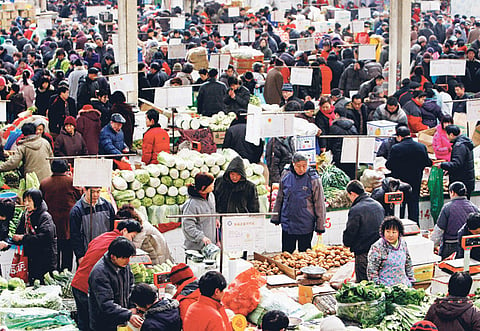
Beijing: More than one in two Chinese savers regard the current inflation rate as unacceptable, according to a central bank survey Tuesday that is likely to fan official concern about deteriorating inflation expectations.
Consumer prices rose 2.7 per cent in the year to February, up from 1.5 per cent in January and flirting with the government's three per cent target for 2010.
Although still modest, inflation now exceeds the 2.25 per cent rate on one-year bank deposits strengthening the case for the People's Bank of China (PBoC) to raise interest rates, some economists say.
"I expect the PBoC will hike its policy rate, the one-year lending rate, in the second quarter, in response to a worsening of inflation expectations, as opposed to CPI [Consumer Price Index] inflation itself," said Ben Simpfendorfer, an economist at Royal Bank of Scotland in Hong Kong.
Fifty-one per cent of depositors questioned a record high since the start of the poll in 1999 said they were dissatisfied with the current rate of inflation, compared with 46.8 per cent in the previous quarterly poll.
The survey's index of future price expectations fell to 65.6 from 73.4, but after accounting for seasonal fluctuations the PBoC said people expected inflation to keep rising next quarter.
Upsetting stability
Premier Wen Jiabao told a news conference on Sunday that inflation, along with income inequality and corruption, could upset social stability and even undermine the power of the state if it got out of hand.
"Governor Zhou may think it unnecessary, but, as history shows, when China's real interest rate falls into negative territory, China immediately increases interest rates — we've just crossed that line," Jerry Lou, Morgan Stanley's China strategist, told reporters.
"In my view, it could take place in April," Lou said, noting that decisions on interest rates are taken not by PBoC Governor Zhou Xiaochuan but by the State Council, China's cabinet.
But he said a 27-basis-point rise in borrowing costs — now 5.31 per cent for a 12-month loan — would be primarily symbolic.
"Chinese business managers really don't care too much about the rate level — in a economy growing at rate of 10 per cent or 11 per cent, it really doesn't matter whether you have to pay an additional 27 or 54 basis points," Lou said.
Real monetary tightening would come in the form of strict controls on bank lending. "What they fear most is that they can't get money anymore, and they have no loan quotas — that will be real tightening," Lou said.
Following a reduction in this year's loan quota to 7.5 trillion yuan (Dh4 trillion) from a record 9.6 trillion yuan in 2009, only 14.8 per cent of Chinese bankers questioned in a separate survey described policy as loose, down from 26.6 per cent last quarter.
But 51.7 per cent of the bankers said they expected no change in monetary policy next quarter.
More than 70 per cent of those surveyed said current property prices were unacceptably high, the PBoC, which published the survey on its website, www.pbc.gov.cn, said.
Save or spend?
Despite the negative real deposit rate, the proportion of families who said they intended to save money rose to 43.6 per cent from 42.0 per cent last quarter, while a slightly smaller share said they would spend more, according to the central bank.
The index measuring demand for loans rose to 69.1 from 67 in the previous survey, largely due to the manufacturing sector.
But the appetite for mortgages eased a possible sign that government steps to cool the property sector are working.

