Arab world ‘must manage risks of transition well in a critical period'
IMF says this is vital time for governments to listen to their people
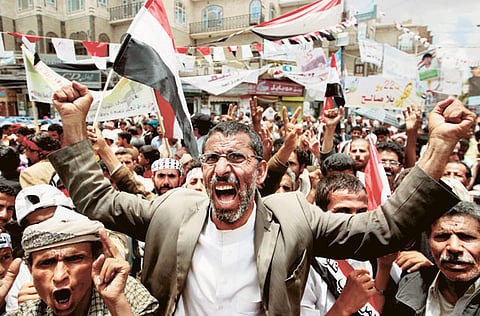
Dubai: The Middle East is moving into one of the most difficult periods in its history and it needs to manage the risks of transition well in order to reap the fruits of the Arab Spring, Christine Lagarde,Managing Director of the International Monetary Fund (IMF), said.
"The Middle East and North Africa region is in the middle of a delicate transition between rejecting the past and defining the future. Although the journey might take some unpredictable twists and turns, I remain hopeful. The final destination is clear: The Arab spring is poised to unleash the extraordinary potential of the Arab people," Lagarde said in a speech hosted by the Safadi Foundation at the Woodrow Wilson Centre in Washington DC on Tuesday.
Lagarde said that with the right economic and social policies, short-term challenges can be addressed and the foundations laid for inclusive growth and job creation.
"While each country in the region must find its own path to change, the over-arching economic goals of the Arab Spring remain clear — higher growth, growth that creates more jobs, and growth that is shared equitably among all strands of society. To achieve that, macroeconomic and financial stability remain absolutely essential.
She said that while the region's destiny lies in its own hands, the international community has a responsibility to help. It must listen to the hopeful voices and provide support including market access.
"The IMF too stands ready to help. We are already offering the best policy advice and technical assistance possible. We will provide financing if requested," Lagarde said.
Almost one year ago, everything changed for the people of the Middle East.
Human dignity
Lagarde said nobody expected an act of desperation against the violation of human dignity by igniting a flame that would eventually illuminate the entire region, toppling governments and leading to a mass awakening of social consciousness.
"We all learned some important lessons from the Arab Spring. While the top-line economic numbers — on growth, for example — often looked good, too many people were being left out," she said.
"And, speaking for the IMF, while we certainly warned about the ticking time bomb of high youth unemployment in the region, we did not fully anticipate the consequences of unequal access to opportunities. Let me be frank: we were not paying enough attention to how the fruits of economic growth were being shared."
It is now much clearer that societies with more equitable distribution of wealth are associated with greater economic stability and more sustained growth.
"At this delicate point in the transition, the risks are not only political, but also economic and financial," Lagarde said.
"We are already witnessing an economic slowdown across the oil-importing countries that is pushing up already-high unemployment and aggravating social tensions," she said. "We must manage these risks carefully."
Dr Nasser Saeedi, Chief Economist of the Dubai International Financial Centre, refuses to accept the term "Arab Spring".
"What the region witnessed over the last year is anything but spring. To me it's a storm — a firestorm. I would like to call it the Arab Firestorm."
He said 60 million or one fourth of the Arab population are poor, earning less than $2 (Dh7.34) per day, one of the root causes of the civil unrest in parts of the Arab world.
"We have some of the richest countries and at the same time some of the poorest people in the region. With 60 per cent [of the] young population below the age of 29 looking for employment and opportunities, the situation is explosive, especially when 20 per cent of them remain unemployed in a society where there are no social safety nets," Dr Saeedi warned audiences at a meeting in Dubai on Monday.
He said if policymakers and businesses do not engage with people and invest in empowering them, those at the bottom of the pyramid would bring down those remaining at the top.
Lagarde warned that people are growing impatient.
"This is to be expected. Momentous changes of this sort — a new society in the making — are never smooth. They are almost always messy and complicated," she said.
Amidst a darkening economic outlook and waning confidence, the Arab Spring still shines as a bright light and a beacon of hope, a symbol of what can be accomplished, she said.
"This is a region that stands at the centre of human civilisation. Names like Carthage and Alexandria and Damascus are forever etched in our collective consciousness. The time has come for the region to live up to its legacy," she reminded the Arab leaders.

