Price war intensifies in Indian aviation market
Experts feel it could be suicidal for the industry in the long run
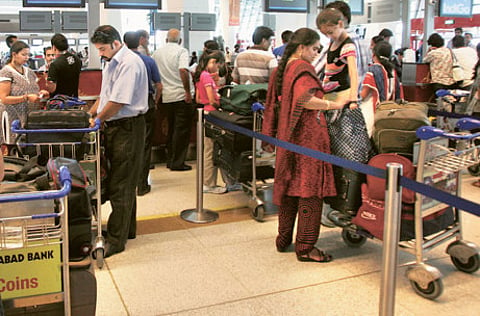
New Delhi: The recent fare war among Indian airlines has drawn a mixed response. While experts claim that domestic budget carriers will not be able to recover the cost incurred on every seat created, travellers rushed to cash in on the big ticket sale.
It began on February 19 with Jet Airways slashing fares on two million seats by more than half for travel through the year. This was on over 450 flights across 57 domestic destinations. Jet announced that under the offer a Rs8,000 (Dh540) one-way ticket from Mumbai to Delhi would cost just Rs2,850.
It introduced four slabs for one-way fares, based on travel distance – up to 750 km: Rs2,250 (for instance, Delhi to Jammu/Srinagar/Varanasi), 750 km – 1,000 km Rs2,850 (Delhi to Ahmedabad), 1,000 km – 1400 km: Rs3,300 (Mumbai to Delhi, Delhi to Kolkata/Pune) and above 1,400 km: Rs3,800 (Delhi to Chennai). These fares were inclusive of all taxes and the offers are valid till December 31.
Following suit
The move prompted rivals IndiGo and GoAir to also slash fares to similar levels on select routes. This, despite the recent concerns expressed by the Directorate General of Civil Aviation (DGCA) and the civil aviation ministry that fare wars could squeeze the carriers fin-ancially.
A DGCA official remarked, “Our job is not to regulate fares and we would not like to interfere in the offers. But our concern is that by trying to outdo each other by offering excessively low fares, the airlines should not hurt themselves financially.”
In January, SpiceJet had offered one million tickets at Rs2,013 for one-way travel between February and April, which led to DGCA giving warning signals. According to an official, “The aviation ministry is now working on fixing a lower-limit for fares to avoid unhealthy competition.”
Meanwhile, Yatra.com, one of the country’s biggest online travel firms, claimed its sales had shot up five-fold when the discounted fares were announced.
The firm’s official Sabina Chopra reportedly said, “The discounts are good news for both consumers and the aviation industry, which has been seeing a fall in passenger numbers for some months now. Such offers will surely reverse the trend of falling passenger numbers.”
Leisure and regular travellers and also people from the corporate sector had made bulk advance bookings, which pushed the sales to astronomical levels, the official said.
Amber Dubey, an aviation analyst at global consultancy firm KPMG, said that Jet’s figures translated to around 10 per cent of its total capacity. “This will only stimulate the market.”
But experts feel it could be suicidal for the industry in the long run. Many felt it was merely a marketing gimmick to attract more passengers In case of Jet it might be able to create buffer cash stock, but the move could be disastrous for other airlines, as they might not be able to recover the cost per seat.
“As in the present scenario, even if the fares draw huge response, airlines also stand to lose out on revenues, which they would have otherwise made for the rest of the year, especially during the festive seasons. Since at that time the airfares go up by about 30 per cent to 40 per cent, the passengers would then have paid a premium price. But now that they have already booked the tickets, the airlines could tend to rather lose on the revenue in the long run,” an expert said.
He said that the motive behind the strategy of offering seats at cheaper prices must have been to increase the passenger load, which in turn would compensate the lower fares. “For the past two years, airlines have not been making enough money. State taxes, which range up to 30 per cent, make the final cost incurred on aviation fuel rise by almost 50 per cent,” he said.
History repeats itself
All this might be giving an impression that airlines are getting aggressive with pricing, but an official of the travel agents association said that earlier too airlines introduced schemes where tickets were sold for travel at much later dates. But this time tickets for immediate travel were also offered at cheaper prices.
Explaining the tactic, he said: “The airlines tried to fill up a certain number of seats and shore up demand on weaker routes. But it is important to take note that the discounted fares apply to only a small portion of the total capacity. For instance, Jet had a capacity of about 16 million seats on domestic routes in 2012. Assuming its capacity remains the same this year, the discounted rates apply on only 12.5 per cent of the capacity and this is not a big number.”
While the era of low fares looks to be making a limited and sporadic comeback, the government is not happy with the situation. For, following a negative growth in air traffic witnessed due to grounding of Kingfisher Airlines, is fresh in everyone’s mind.

