Emirates continues to buck the trend
As the Dubai-based Emirates celebrates 25 years of service excellence, the airline continues to deliver profits year after year while expanding operations
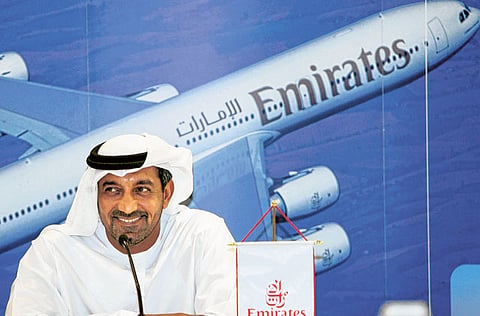
What started with a cheque of $10 million (Dh36.7 million), a small team of professionals and two aircraft painted with the livery of Emirates in 1985 has turned into one of the world's biggest airlines in just 25 years.
Today Emirates celebrates its 25th anniversary with 150 aircraft in fleet that connects 105 destinations across six continents and has another 204 aircraft on firm order worth $68 billion (Dh250 billion) at list prices.
The airline, part of the Emirates Group, currently employs 49,950 professionals and last year carried 27.5 million passengers - in, out and through Dubai International Airport - strengthening its position as the world's fourth biggest international transit hub.
"Although we did have big aspirations for Emirates at the time, I could never have imagined the incredible success that followed the first flight to Karachi on 25th October 1985," Shaikh Ahmad Bin Saeed Al Maktoum, Chairman and Chief Executive, Emirates Airline and Group, says.
"In a short span, Emirates became a key player in the industry, with many in awe of how quickly we built and shaped this incredible entity."
In sheer numbers, Emirates has not only far outshined its regional rivals to become the biggest airline in the Middle East and North Africa, it has now become the most powerful Arab brand globally. For many Westerners, Emirates is the face of the Arab world that also reflects the growing economic power of the region.
Emirates' achievements must be put into perspective, especially having started with only $10 million, not a princely sum even back then for such an enterprise, and having received no further subsidies, protection or hand outs since then, Shaikh Ahmad says.
Saj Ahmad, UK-based aviation analyst with FBE Aerospace, told Gulf News, "For an airline set up in 1985, with the exception of its first year, the airline has turned a profit every year thereafter. It is an achievement few other airlines can attest to and with Emirates future plans clearly on global expansion, it is difficult to argue against the airline doing just as well, if not better in the next 25 years, particularly as it is so financially strong and has a much bigger operating base from which it will grow its business."
Certainly, it has not always been smooth sailing for Emirates, especially being in an industry that, according to the global aviation watchdog International Air Transport Association (IATA) has made cumulative losses of $50 billion in a decade.
"We have weathered the worst economic turmoil in decades, volatile fuel prices, global health pandemics, protectionist governments and their stunted state policies and regional conflict," Shaikh Ahmad recalls.
"Today, we are commemorating the birth of a global brand and an incredible journey of 25 years that began when the first flight of the first national airline of the UAE took to the skies. The air then seemed to be filled with excitement, spirit and hope, and these sentiments and energies continue to dominate Emirates' world today."
The Dubai factor
While the global aviation industry continues has struggled for nearly a decade, one wonders how Emirates keeps on bucking the trend.
"Some of the success is attributable to the Dubai factor - that has indeed resulted in growing passenger traffic into and through the UAE and Emirates has capitalised on this by providing ever expanding air services out of its Dubai hub," Saj Ahmad says.
"The principle two reasons to Emirates' success are based on Dubai and to a wider extent the UAE introducing a policy of growing air traffic services and secondly down to the exceptional management team at the airline."
Shaikh Ahmad acknowledges the importance of the Dubai factor. "Together with Dubai, Emirates has grown and prospered. Working in tandem, the city and the airline have defied expectations, building an international business and leisure destination, alongside a highly successful and profitable airline."
John Siddarth, aviation analyst with research firm Frost and Sullivan, agrees. "The Dubai Factor has contributed to the growth of Emirates, however most of the credit for success would be for the strategic route planning. Emirates had a fleet of about 35 aircraft in 2000-01 and flew to about 55 destinations," he says.
"In 2010 the fleet size of Emirates has grown more than four times and is currently at about 150 aircraft."
The open skies policy has helped to a great extent to strengthen Dubai's position as a hub.
"But importantly, the government has given the airline a virtual free hand to co-ordinate its business by reaching all corners of the Earth and filter traffic through Dubai as the centre point of the global map," Saj Ahmad says.
"Where some airlines talk about their plans, very few achieve those goals - Emirates however, has proven that it can walk the talk and demonstrate to acute perfection how successful its strategy of growth has been."
Siddarth agrees. "Dubai's open sky policy was definitely a catalyst to the growth, the primary driver would be the effective leadership team of Emirates airline" he says.
With the backdrop of such phenomenal success, one wonders - what future holds for Emirates?
"We'll see an airline dominated by A380s, A350s, 777s - it will more than double its global route network footprint and will probably be the first Arab airline that will embark on an acquisition policy that will give it access to new markets so that its business can expand further still," Saj Ahmad says.
The likelihood of Emirates either joining or starting a new airline alliance is very real - the leverage Emirates has is enough to keep Oneworld, Skyteam and the Star Alliance on their toes, he thinks.
"No one can afford ignore them, yet Emirates will be the player calling the shots here. And I also suspect it won't be long before they decide to move to Al Maktoum Airport and capitalise on the huge available capacity to feed their network," Ahmad says.
Siddharth says Emirates is well positioned in the industry as a full serviced carrier. "The focus for the next ten years must be to grow organically. Emirates could look at acquisitions taken careful consideration of the new market opportunities it could provide," he said.
Subsidy issue
Over the past few years, Emirates has come under heavy attack from other carriers accusing it of benefiting from subsidies — something that they never been able to prove. The airline publishes its audited results every year and posts it on its website.
"The argument about subsidies is a myth - Emirates pays its way like everyone else," Saj Ahmed says.
"This airline has a management team intent on making the company the best entity in the industry and they are virtually there - you simply cannot dismiss Emirates success as based on monetary handouts - the majority of its success has been down to its own efforts."
Challenges
The real challenge for the airline will come from European airlines lobbying the EU to curb Emirates' growth. But that's not going to happen given the huge quantity of orders the airline holds with Airbus, aviation experts feel.
"Europe can't afford the backlash and Emirates knows it. The other threat could be possibly from the USA where concerns about traffic coming from the Middle East may raise security issues," Saj Ahmad says.
Overall, the challenges facing Emirates will likely be endured by others too. Economic and operations factors might add to potential challenges, experts say.
Emirates has ordered about 90 A380, a majority of which are expected to be a part of the fleet by 2020.
John Siddarth of Frost and Sullivan feels the key challenge that Emirates would be effectively utilising its new A380 fleet.
"Emirates would need to identify potential routes either through identifying new markets or penetrating into existing markets," he says.
"Emirates cannot afford to under utilise an A380 in low traffic sectors. This would be a key challenge that Emirates needs to tackle, failing which this would be a major threat to the profitability of the airline."
Emirates has proven that network carriers needn't been inefficient - many US and European airlines should be taking a leaf out of Emirates' book and reevaluate their business models, Saj Ahmad says.
In the last 25 years, Emirates has made sure that it evolves its business with the industry — it hasn't rested on its laurels or ignored the market — the airline has adjusted and grown and shows no sign of stopping.
Do you fly with Emirates when you travel? What have your experience been like?

