Waiting for lift-off
Lebanese filmmakers Joanna Hadjithomas and Khalil Joreige pay tribute to their country's space pioneers, while raising questions about the changes that stifle their land today
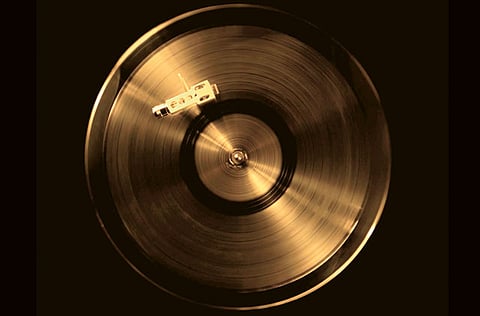
Lebanese filmmakers and winners of the Abraaj Capital Art Prize 2012, Joanna Hadjithomas and Khalil Joreige, are presenting three new bodies of work from their ongoing project Lebanese Rocket Society in their first solo show in Dubai. The new works include a photographic series, a video and sound installation, and a rug.
The well-researched project recalls memories of Lebanon's forgotten space programme to question the notion of monument and collective dreams; and to examine perceptions of the past and present and the imagination of the future.
The project was triggered when the two filmmakers came across a picture of a rocket bearing the colours of the Lebanese flag. Their research revealed that the rocket, named Cedar, had been developed by the Lebanese Rocket Society, a scientific space exploration project established by professor Manugian and his students at Haigazian University. And that they had launched over ten Cedar rockets between 1960 and 1967, leading to much national celebration and the release of a commemorative stamp.
"It was amazing to learn that Lebanon had the first space programme in the Arab world, and that it was not a military but a scientific project. It was interesting because such programmes are rare in this region and also because it has been completely forgotten now. We saw it as a symbol of the ability of the Arab people to be dreamers, researchers and contemporary thinkers, as well as of the lost Arab dream of the Sixties. We decided to make a film about the project to raise questions about the events in our country and the region after 1967, and to make people think about how they want to be represented and why we cannot dream again. Interestingly, while we were working on our film, the uprisings in the region happened, indicating that our ability to dream has not been lost," Hadjithomas says.
Their extensive research included speaking to people involved with the Lebanese Rocket Society and tracing archives and photographs. They felt that the physical presence of the rocket was important for the film and hence they built a life-size sculptural model of Cedar IV, which was exhibited at the Sharjah Biennale 2011. But, instead of the colours of the Lebanese flag, their rocket is painted a ghostly white. The photographic series in this show, titled Restaged, documents a re-enactment of this rocket's journey through Beirut, to Haigazian University, where it is now permanently installed.
But, while the surroundings are clearly visible in the images, the rocket is seen just as a hazy presence. "This re-enactment was important to view the nostalgia of the past in today's context. But getting permission to stage this journey of a missile-like object through the city was difficult. These pictures of the blurred rocket passing through the streets of contemporary Beirut represent how the passage of time has blurred our memory and degraded the collective perception of a celebrated symbol of progress and scientific achievement," Joreige says.
The video and sound installation, titled The Golden Record, also links the past and present.
"This is based on reports that the Cedar rockets carried a radio transmitter with the message ‘Long Live Lebanon'. We also know that some years later, the American spacecraft Voyager 1 and 2 broadcast sounds from Earth as a message to extra-terrestrial beings. These were engraved on golden records, so we combined all these ideas to create an installation featuring a projected image of a golden record turning on the record player, accompanied by the various sounds from the 1960s," Hadjithomas says.
The soundtrack includes memories of members of the Lebanese Rocket Society, and revolutionary speeches by international and Arab leaders from the 1960s, highlighting historic events such as the space race and ideas of pan-Arab solidarity. The disembodied voices from the past have an uncanny relevance to contemporary politics, connecting forgotten achievements with future aspirations.
The third artwork, titled A Carpet, is a rug depicting the Cedar IV rocket stamp issued in 1964.
"This rug was produced in Armenia to acknowledge that the Lebanese Rocket Society was born in an Armenian University. It is also connected to a story we heard about young Armenian girls, who were survivors of the 1915 genocide, and produced magnificent carpets in the 1920s at an orphanage workshop in Lebanon. Our research revealed that they had gifted a carpet to American president Calvin Coolidge as a token of gratitude for American support of their workshop," Joreige says.
"The carpet was initially displayed in the White House, but later removed for political reasons. Like the Lebanese rockets developed by descendants of these Armenian weavers, the carpet created by them has also been forgotten. So this rug pays tribute to the strength of a group to survive, aspire and dream and reminds people of the idea of expressing gratitude, which is missing from our society today," Joreige says.
Hadjithomas adds, "This project is about actively reviving forgotten history and dreaming about the future. Its final part, which is our film, ends with a ten-minute animation imagining how Beirut would be in 2025 if the rocket project had not been stopped."
Lebanese Rocket Society: Part III, IV, V will run at The Third Line until April 19.


