Scenes from a receding past
Patrick Flavin's works are heavy on detail, revealing the painstaking process of their creation
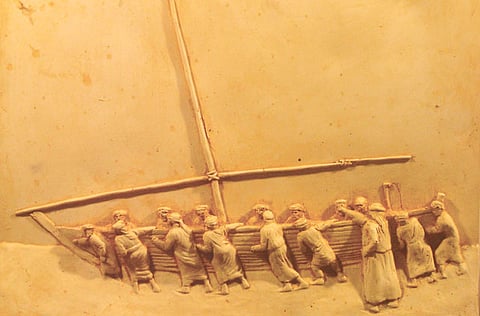
Patrick Flavin's sculptures speak about his love for this region and his eye for detail and composition. Most of the Irish artist's bas-relief and free-standing sculptures are based on Arabian themes, featuring wind-tower houses, minarets, Islamic arches, camel caravans and goat herds. He skilfully recreates scenes of traditional dancing, fishermen on their dhows, a pearl trader showing his wares to a customer and groups of people in traditional Arab dress.
The artist pays great attention to details such as the delicate lattice work and decorations on the buildings, the embellishment on the clothes and jewellery and the textures of the different elements in the composition. He also does still-life works featuring traditional pottery and brassware. But his most striking artworks are his expressive portraits.
"I am a representational artist and my main interest is the human form, especially the face. I believe that the most expressive art is that which focuses on the face. I find the human face fascinating as a structure and see it almost as a map of a person. And I get a great deal of enjoyment from creating a lifelike piece of work from an inert lump of clay," he says.
The faces in his sculptures are based on people he knows, found images and characters from classical paintings. He also does humorous caricatures from his own imagination. And his layered compositions are inspired by Orientalist paintings, famous photographic works, and the drawings and etchings of masters such as Rembrandt, Donatello, Ghiberti, Da Vinci and Rodin.
It is surprising to know that Flavin has no formal training in sculpture. "My only exposure to sculpting was during childhood, when I played with Play-Doh. My father always bought us plasticine, and I used to be quite good at modelling. But I gave it up as I grew older," he says.
The artist is an English-language teacher by profession and has lived and worked in Sudan, Greece, Egypt, Ecuador and Saudi Arabia, before moving to the UAE 15 years ago. "I used to do a lot of drawing, which has helped me as a sculptor. But I began sculpting only after coming to the UAE because I felt settled enough to take up the hobby. I taught myself the techniques from books and online information. I depict the people and things I see every day, and that is the main reason for the predominance of Arabian themes in my work. But I also like to work with Assyrian and Mayan themes because relief sculpture originated in Egyptian and Assyrian art, and Assyrian and Mayan reliefs are some of the most striking and beautiful in the world. They have not been surpassed in technical skill and strength of presence until today and it is a great challenge for me to recreate them," he says.
Flavin's distinctive signature is the aged, sepia look of his sculptures. And he uses the elaborate, time-consuming classical technique to achieve this. "I try to evoke a bygone age, both in subject matter and technique, because I feel sad that in today's world we are beginning to lose sight of many of the skills that go into the production of art. There is less and less emphasis on human anatomy and many of the skills and crafts involved in art production, such as mould-making and casting, are being lost. The production of each of my pieces involves a long process. It begins with the modelling of the clay, making a rubber mould and then casting it in either gypsum or resin. I then finish the piece by hand, using pigmented wax to give the aged appearance. The whole process takes up to ten hours, but I like the fact that I have control of every aspect of it. And the nice thing is that even though each piece is part of a limited edition, being hand-finished it is unique and different from every other piece in the edition," he says.
Flavin would welcome galleries or other outlets that would like to show his work.
Patrick Flavin's exhibition will run at Gallery 76, Dubai International Art Centre, until April 9.


