Decisive moments
A tribute to Eve Arnold's ability to be in the right place at the right time
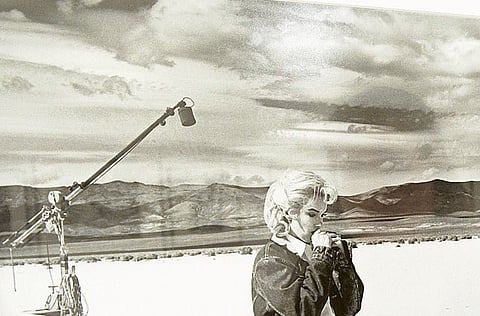
What drove and kept me going over the decades? What was the motive force? If I had to use a single word, it would be curiosity." This quote from the pioneering photojournalist Eve Arnold, who died in January, aged 99, is among the various first-person wall texts that punctuate All About Eve, a retrospective of her work. Just how curious she was is evident in the timeline of the projects she undertook in her long career. It takes up one whole wall and makes for an illuminating read, not just because of the longevity of her career — from the late 1940s to the 1990s — but for the range of subjects she tackled.
In 1978 alone, for instance, she shot several portraits, including Dirk Bogarde, Francis Bacon and Irene Papas; advertisements for Optrex, the English Tourist Board, Pentax and Rolex; and assignments on the White Jews of Cochin, Indian troubadours and the London Symphony Orchestra for the Sunday Times magazine. All About Eve is essentially a celebration of Arnold's life and work, the photographs chosen by her close friends — the curator Zelda Cheatle and the academic Brigitte Lardinois, who worked closely with Arnold at the agency in the 1990s. It is a big, wide-ranging show selected from the vast archive of one anonymous private collector that includes many of Arnold's best-known photographs — a series each on Marilyn Monroe and Malcolm X. There are one or two surprises.
The first is a beautiful self-portrait from 1948 which greets you at the entrance to the show. Here she looks young, chic and totally at ease before her own camera. As with many Eve Arnold photographs, it comes with a story attached. Apparently she was accidentally locked into a friend's studio in Pennsylvania and, bored, began photographing herself to pass the time. The result is characteristically self-assured.
The earliest pictures in the main gallery are her studies from 1951 of a group of black migrant labourers who journeyed north every year at harvest time to work on white-owned farms in Long Island. There are perhaps unconscious traces of the 1930s work of Walker Evans and Dorothea Lange here, but Arnold's sombre and slightly surreal group portrait of the farm owners, the Davis family, enjoying a picnic among the graves of their ancestors, is all her own. Throughout, you marvel once again at Arnold's ability to gain access to her subjects at work and at play.
Her many portraits of celebrities — which she called "personalities" — are the product of a more open and innocent era, when stars were not so paranoid about controlling their image. There is a beautifully intimate shot of film director John Huston and his then teenage daughter Anjelica, sketching. Arnold caught a young Michael Caine cavorting playfully with Candice Bergen in a break from shooting The Magus in Majorca, and Marilyn Monroe lunching in the woods with husband Arthur Miller on the set of The Misfits. There is a great shot of a young Andy Warhol deeply engrossed in a painting in the Factory in New York, and another of a luminous Mia Farrow in rehearsal. I have always been drawn more to Eve Arnold's in-depth reportage, the great commissions she did when she was very much a pioneering woman in a man's world. Again, her ability to be in the right place at the right time, and to catch it up close and personal, is almost uncanny. Her photograph of leaders of the American Nazi party attending a Black Muslim rally in 1961 — they were united in the belief that America should be racially segregated — has a chilling power 50 years later.
A snatched black-and-white portrait, titled Divorce in Moscow, USSR, 1966, is powerful in an altogether different way. In a drably functional room, a distraught man looks away from the camera to the right, while his wife stares stoically off in the opposite direction. The body language speaks volumes: His head rests on his hand; her hands are clasped tight, her wedding ring just visible. The physical space between the couple is minimal, but the emotional space is vast. In the background, oblivious, a man reads a newspaper, while another is engrossed in a book. Arnold catches the full weight of this fraught moment, and the universal truth that great personal suffering, as Auden put it, often "takes place when someone else is eating or opening a window or just walking dully along". It's an extraordinarily poignant photograph: the decisive moment rendered just as powerfully, if not more so, as in a great piece of observational writing or filmmaking.
All About Eve: The Photography of Eve Arnold is on at Art Sensus in London through April 27.


