A language in the pattern
Furniture and jewellery that draw upon traditional Middle Eastern designs
André C. Meyerhans has designed many award-winning architectural projects around the world, including the new Garhoud bridge in Dubai, which won the prestigious MEED Award in 2010. But the Dubai-based Swiss architect's creativity is not limited to urban architecture. In his first solo exhibition in Dubai, organised by JAMM Art & Beyond, on display are a range of art objects, furniture and jewellery.
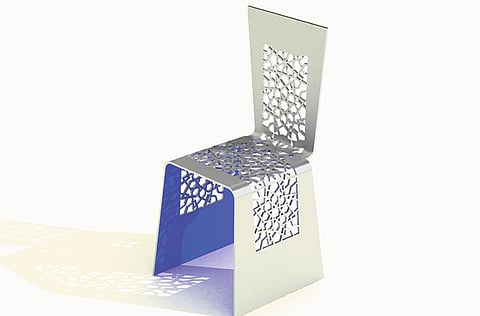
The artworks are inspired by traditional geometric patterns seen in Islamic architecture, but the artist has played with them to create his own contemporary interpretation. In his furniture pieces and lights, the patterns have been cut on aluminium, and they are highlighted by the bright colours painted on the inner surfaces of the pieces, leading to a nice interaction between the metallic lattices, the shadows they create and the glimpses of colour.
The furniture includes "Space Clips" that can be used as side tables or stools, the Space Bench, the Space Chair, the Tic Tac Table, the Table Cloth, the Centipede Bend-It benches, and the striking "Mashrabia Cubes" used as lights. Other objects on display include the Mashrabia Stele, art objects made from steel, acrylic and mirrors, and limited-edition silver jewellery.
"The starting point for my work was pure maths. My thesis for my masters degree in architecture was about an equation that would generate space with identical elements. Later, I discovered the potential of geometric arrangements and started investigating how patterns and structures can be defined through geometric principles. But I have travelled extensively in this region and have been living in Dubai for the last ten years. And since Islamic culture has focused on and developed non-figurative decoration for centuries, its vast pool of graphic-geometric elements has been a rich source of inspiration for me. So, this series explores how traditional Middle Eastern ornament can be translated into a contemporary language. I have played with the logic rather than the pure geometry of the patterns, and experimented with the hierarchy, symmetry and repetition of the patterns by taking them apart, rearranging them, making them lighter or more dense and developing linear patterns in a second dimension," Meyerhans says.
Each piece reinterprets historical geometries in different ways. The Space series of furniture uses deformation, decomposition, fractal reading and selective grouping of traditional patterns to explore non-periodic structures. In the Bend-It bench, elements have been cut and bent out of a flat sheet to create a harmonious design. And in the Mashrabia Cube the traditional hierarchy, symmetry and repetition have been eliminated to create a random, perpetual pattern.
Meyerhans has used Japanese origami-style folding to create a more open, complex pattern in the decorative Mashrabia Stele. And in the 3-D Tiles, he has used stainless steel, coloured acrylic sheets and mirrors set at different angles to create depth, distortion and a three-dimensional effect. These pieces, suspended from the ceiling, reflect the surroundings and incorporate them into the work representing the noise and chaos in the environment today.
"The bright yellows, blues and greens in the furniture express the way colours come alive in the strong sunlight in this region. And I used fuchsia in the Mashrabia Cube to symbolise the dynamism and confidence of the young people of this region. I used aluminium and steel because the rough and raw industrial materials contrast with and balance the sweet and mellow designs and the warm and vibrant colours," Meyerhans says.
He has been designing jewellery for a long time and is well known for his one-of-a-kind pieces made from antique beads. The silver jewellery displayed in this show offers a preview of a line he plans to launch later this year. Here too, his designs play with simple geometric arrangements, putting together elements to create new and larger patterns. Fractions of a circular pattern on rings and bracelets come together to form a floral motif in the pendant and bracelet of the Rose set and tiny water-drop-like elements combine to form interesting patterns in another set. The orthogonal layout of the pieces gives them a textile-like fluidity and the play of light on the sculpted surfaces adds to their beauty.
"I believe that there can be no boundaries in creativity and that new insights and ideas come from thinking outside the box and mingling with people from different fields. Hence, my creations range from multibillion-dollar urban projects to art objects and jewellery. Through my research, I have tried to develop a contemporary Middle Eastern language that can be applied to architecture and art and design," Meyerhans says.
Jyoti Kalsi is an arts enthusiast based in Dubai.
Design by André C. Meyerhans will run at Toby Arts, Al Quoz, until May 15.


