A break in the pattern
Two artists use different media to explore the common theme of ornamentation, and the lack of it, in art and architecture
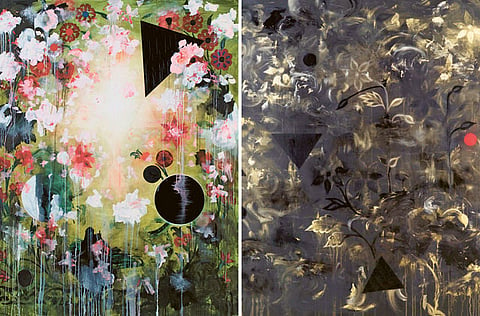
The conflicted relationship between the decorative tradition of ornament and Western Modernism is the theme of Brute Ornament, a show featuring latest works by New York-based artists Kamrooz Aram and Seher Shah.
Aram, who is of Iranian origin, uses Persian motifs in his paintings to re-examine the way we look at ornamental art. Shah, who was born in Pakistan, draws on her training as an architect to contemplate the lost ideals of Brutalist architecture that is devoid of ornament. The show is curated by Murtaza Vali.
In his earlier work, Aram has used various icons inspired by his Iranian heritage, but in this new work he has moved from iconography towards an iconoclastic approach. Although he has used floral patterns from Persian carpets, in many places the artist has wiped out the motifs from the canvas or covered them with black paint — and then repainted them.
"In this work, the process itself reflects the meaning. When a pattern is repeated it becomes ornamental, but here the idea is to brutalise ornamentation," Aram says.
"These paintings are in a state of being built and destroyed and rebuilt. Hence, the floral pattern is interrupted and it is struggling to become a repetitive pattern, which could be called ornamental. The conflicted situation in which the ornaments are placed, reflects the relationship between ornament and pure abstraction," Aram adds.
He has also used geometric shapes — such as triangles and red dots — in his work as references to the spirituality in Islamic art, the history of modern geometric art and the role of ornament in the development of modern art in the West.
"The patterns of Persian carpets, especially the medallion carpet, represent different stages of spiritual development. Hence the Persian carpet is not just a decorative object. Like a modern painting, it is a work of art that has a deeper meaning. By bringing these two art forms together in my work, I want to create something meaningful that references the carpet and is a painting," he says.
The artist uses references to modernists such as Frank Stella, Paul Klee and Cy Twombly to question perceptions about decorative and modern art. And some of the titles such as Backdrop for an Anxious Interior also reveal his own inner conflicts.
"For many years I struggled against the idea of my work being beautiful because I was cautious about it becoming decorative. But now I realise that for an artwork to have critical content it has to accept part of its role as decorative. By imposing carpet patterns on Frank Stella's ‘black paintings' I want to question the false understanding that one is decorative and the other art, and state that both are decorative and meaningful," he says.
While Aram negotiates the complicated space between two art traditions, Shah's work is all about investigating personal spaces. Her mystical graphite drawings feature a series of turbulent, fantasy landscapes that combine architectural drawings of real buildings with imaginary cityscapes, free-standing columns and walls, vector lines, cloudy vistas, swirling arabesques and other ornament.
The centrepiece of this series is Object Relic, based on the Unite d'Habitation, Le Corbusier's iconic building developed in the 1950s as a prototype for social housing.
"This new Brutalist architecture, devoid of ornament, started out as low-income housing for the masses, and this building became the inspiration for social housing projects around the world," Shah says.
The artist, however, adds that these cold, inhuman structures have mostly resulted in the marginalisation of the people inhabiting them. In essence, the structure failed to realise Corbusier's original vision. Shah also says that what she finds interesting is that this rectangular block — the building — which is quite disconnected from the landscape, is very Utopian in its ideals, but fails on these ideals because it disregards the idea of the individual.
"In my drawing," Shah says, "I have flattened out the Unite building, stretched it out in perspective and situated it in an imaginary landscape to look at the iconic modern structure as a ruin or relic."
The complex patterns of geometric shapes in this drawing are broken by strings of flag-like shapes inspired by prayer flags in monasteries, and a huge black wall standing in the middle.
"The flags represent ornament and individuality and also allow me to introduce movement into the rigid architectural grid. Whereas, the black wall, which erases part of the drawing, is a means of separation that represents the rigid authoritarian nature of Brutalist structures and the inherent anxiety that exists between the organic and structural nature of the grid," Shah says.
In other drawings, she plays with the modular system of the Unite building and other architectural perspectives — turning and bending the walls, constructing, deconstructing and reorienting them and obliterating vistas, setting and breaking down controls on viewing perspectives through dark monolithic walls, columns, gates and grids to convey ideas of repetition, transformation and tension.
"For me the premise of Brute Ornament is about examining the vexed relationship between the idea of decorative styles versus Brutalist architecture that strips away any idea of ornament. And I see a dialogue between my work and Aram's in the sense of the idea of anxiety about how art gets categorised and the idea of reinterpreting historical context either by erasing or changing perspectives," she adds.
Brute Ornament will run at Green Art Gallery until May 5.


