I don't deal with myself as a brand: Alexa Chung
When she gets dressed, the high street cashes in — Alexa Chung is a force of fashion
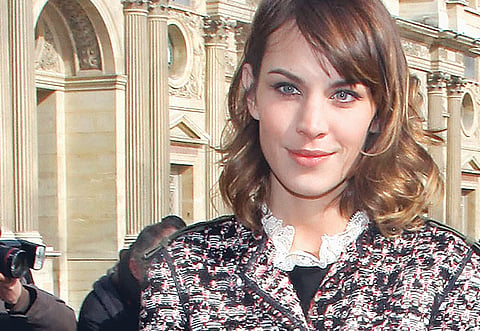
In the print room at Central Saint Martins, it's as if I'm watching a high-budget dramatisation of how fashion works. To my right, 20-year-old students in top-knots, rubber gloves and Violent Cancer t-shirts hunch over their silk-screens, like Mary Katrantzou did four years earlier. And to my left, the British Fashion Council's new "young style ambassador", Alexa Chung, is posing against their paint-splattered door in a dress by Peter Jensen, a designer who, like Stella McCartney, Alexander McQueen and Christopher Kane before him, studied in this institution.
It's like a 3D timeline, from inspiration to success. It's fashion physics. Style algebra. Student x Central Saint Martins + Alexa Chung = trend. I take a deep breath of the inky fumes and cough indelicately. A fire alarm shocks through the building and everybody calmly begins to file down the stairs in a cloud of pink hair and enthusiasm, Chung singing quietly along to the rhythm of the alarm. Could fashion really be this simple?
Mulberry's "Alexa", their £700 satchel, was inspired by a vintage Mulberry briefcase they'd seen Chung using as a handbag. Last year the brand quadrupled its profits, in part due to the sell-out success of this one bag — a bag that Chung was photographed carrying in all its leopard-print, calf-skin, patent, oversized incarnations. Even aside from the pieces that carry her name, Chung's boyish style (she appears frequently on Vogue's "best dressed" list) has been harvested and replicated, with Chung-ian touches (mannish brogues, Peter Pan collars) flooding the high street. She is a force of fashion. Why?
"Alexa is one of those rare girls who is beautiful, but with a look that somehow still feels achievable," explains Grazia editor Jane Bruton. "She is as reliant on clever high-street finds as she is on designer pieces, and she doesn't do unrelenting glamour, she does clothes for everyday urban life, rather than the red carpet. Therefore her style becomes more transferable than that of a lot of the A list."
Are Chung and her contemporaries aware of the impact they can have on an industry that depends on such wobbly variables as taste, and weather?
Mat Bickley is the founder of Joyn, a digital marketing consultancy that works with fashion brands to track and analyse online responses to celebrities, establishing just how they affect sales. According to him: "Celebrities are aware of their influence, if not exactly who it is that finds them influential. Many celebrities start by endorsing other people's brands, but quickly move into the arena of fronting their own collections."
‘Bin man' trend
Chung, for example, designed a leather-backed coat for Madewell, which Grazia said triggered a "bin man" trend.
"It's a bit surreal," Chung says of her huge commercial influence, propping her chin on her hands. "I don't deal with myself as a ‘brand'." Her scrunched eyes imply she's embarrassed even to admit she's aware of such a concept. "So I'm told about the influence I have, but it's not ‘me'. It's ‘Alexa Chung'. It does make it difficult to shop, though. I walk around thinking: ‘Hmm, everything's a bit samey.' Then I realise that the stuff I think is samey — like the saturation of Peter Pan collars — comes from me." She doesn't have to do much shopping though clothes come to her. "Yes, but that easy access to fashion has cheapened it a bit for me. It's a fast pleasure now I miss that thrill I felt when I got my first Mulberry bag. I've lost that hunting instinct. So even though I can wear anything now, it's not any easier to get dressed." She has, she says, ‘a floordrobe'. "But I've gained clarity" Clarity? "I can see the difference between wanting to buy into a brand and being inspired by a certain piece. Do you know what I mean?" I think I do.
It's a privileged skill, but one that's certainly helpful for her new role with the British Fashion Council (BFC), for whom Chung's first job is spokesperson for the British Designers Collective, a pop-up store showcasing emerging designers' work. Harold Tillman, chairman of the BFC, elected Chung because, he says: "Alexa's fashion influences are evident in the industry through her roles as creative director, brand ambassador for several labels and muse to designers. All credit to her distinctive personal style."
As a teenager, Chung applied to study at Central Saint Martins. "But I didn't get in," she says, with a sad emoticon face. "So I feel a bit jealous of these guys," she adds, waving her hand in the direction of the fashion studios, "like I want to join in. I should've done this. I'm from a family of designers, so this feels very natural to me. And I veered into TV, but always end up in fashion one way or another. I suppose, even though I didn't get in to Saint Martins, I managed to leapfrog the process.
Ambassador for British fashion
"And I'm genuinely really excited to be an ambassador for British fashion, especially after spending so much time in the US. That's where I realised why I'm proud to be British. With our manners, and our self-deprecation. And the way we have fun! London Fashion Week is so different from any of the others. Compared to the strictness in New York, London seems freer from commercial constraints. Truer to the process, to street style, to a sense of humour."
Her sense of humour, always cheeky, always dry, breaks only when she feels like she's not being heard. The photographer is persisting with a shot that's not working. So she takes a swig of Coke and puts her foot down. The photographer's assistant averts his eyes as she quietly explains about the light, and the dress, and the pose, and when he takes a shot she asks: "How does it read?" It's unusual to hear a model talk back and I tell her it was a bit thrilling. "When I was a model," she whispers, "I started with an opinion, but was encouraged to lose it. It began as play-acting, but then I lost sight of myself a bit: so when I did the audition for [British TV series] Popworld and they asked my opinion, I felt like crying with happiness."
We trail through the building together, the knitting room with its quiet roar, the balconies' vast, clean floors echoing with the sound of her wobbly heels. In the print room she is taken with the drawing of a Mexican queen that a student called Milligan Beaumont is turning into a scarf. I hear her complimenting the student gently, saying: "Don't you think it would be amazing as a shift dress, in black and white?" Beaumont ignores the suggestion. "Maaake it, maaake it," Chung chants, jokily. "I'd wear it!" Beaumont doesn't take the bait.
Upstairs, in a box-like room behind the MA students' rails of glittering dresses, sits Professor Louise Wilson, director of Central Saint Martins' fashion course, and the person many credit with having shaped British fashion over the past decade. Since 1992 she has taught Alexander McQueen and current stars Mary Katrantzou, Christopher Kane and Giles Deacon.
I ask Wilson a question I've been pondering: how does fashion work? Chung is an example of the impact of influential bloggers and celebrities. How can Wilson, the person behind the clothes we wear, explain the process to me? She locks me in a look. I lean forward to hear her secret. "There aren't 10 easy f***ing rules, OK?" OK. "You wouldn't ask Freud: ‘Can you show me how to make a painting?', would you? You wouldn't dream of asking an F1 driver to show you quickly how to build a car. How does it work? Listen, it's a life experience. It's about skills, education. Sorry, mate, not everyone can be in the club."
Again, a sigh. "The problem with British fashion," she says, "is that it's got too fashionable."


