Stories from the soul
Winners of the ‘Arabic Booker’ fiction prize, talk about the inspiration behind their works
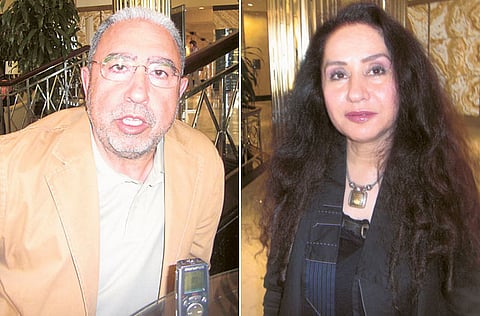
Arabic literature is on the rise again, more visibly than ever before in living memory. Flashes in the pan such as Naguib Mahfouz, the late Egyptian Nobel laureate, gave succour to generations of brilliant minds that had remained suppressed by the political machinations consuming the region.
In this year of the great Arab awakening, there was real talk of Adonis being the frontrunner for the Nobel Prize for Literature (which was eventually awarded to Tomas Tranströmer).
But it is only appropriate to focus the spotlight on two other writers who, earlier this year, have jointly won the International Prize for Arabic Fiction — the "Arabic Booker". This is managed in association with the Booker Prize Foundation in London, with support from the Emirates Foundation in Abu Dhabi.
These two writers are Raja Alem and Mohammad Al Achaari, and both their novels touch upon contemporary sensitive issues. They deserved their share of the $50,000 (Dh183,500) prize and recognition for their talent.
As a young woman writer from conservative Saudi Arabia, Alem explores — some would say exposes — the murky world of corruption, crime, sex and the exploitative hold of the building mafia in Makkah, in her delicately titled book The Dove's Necklace. On the other hand, in The Arch and the Butterfly, Achaari, a renowned Moroccan poet and former culture minister, sketches the trauma of an ordinary family when they discover that their otherwise-well-behaved son is in reality an Al Qaida operative who dies a "martyr" in Afghanistan.
Excerpts from an interview:
Mohammad Al Achaari
How do you feel about jointly winning the prize with Saudi Arabian writer Raja Alem? Are you satisfied with this sharing of honours?
Frankly, I think the award commission is responsible for its decision, and a joint award does not mean that my novel has got only half the recognition. I consider that the prize was given to both novels on an equal basis. The interpretation given by the commission is available, acceptable and convincing. A joint award is a rarity and I accept it as such.
You are a poet, how did you come to write a novel?
I do not think there are restrictions on writers of different genres. Dealing with reality alone is not enough to tell stories. If so, editorial writers and sociologists would have become great novelists. Imagination, construction and language are the three essential elements of a novel, although it often seems to me that quite a few writers consider language a secondary element. I would say language is the most essential requirement, which explains why poets often write good fiction. Without the love of language you cannot establish a real relationship with writing, whether fiction or non-fiction.
What inspired you to write ‘The Arch and the Butterfly'?
The many problems and issues of life in Morocco that I have experienced were accumulating in my mind over a period of time, creating a sort of Roman mosaic. It is these small details of society, with all their contradictions, weaknesses and strengths, complexity of characters, and physical and psychological situations, that draw in the reader. That just about summarises the birth of my novel.
Do you think religious extremism is as alarming and dangerous for Moroccan society as your novel describes?
I think extremism is a threat to all societies in the world. We are not the only ones affected. Take France, an old democracy that is now faced with the horror of rising right-wing extremism in the form of the National Front. These "neo-patriots" are inspired by groups pursuing European fascist ideologies that remain a threat to democracies all over the world.
Arabs believed for a long time that their dictators would be able to protect them from extremism. But this was nothing more than an illusion, because we ended up suffering the bitterness of dictatorship more than the horrors of extremism. And both of these had pretended to protect us.
All I can say is nothing can fight the evils of extremism as effectively as a genuinely democratic society. Any attempt to fight the extreme right through dictatorial means will only strengthen the dictatorship. Hence there is no place for confrontation in our society. If we must confront them, let us do it through the people and public opinion.
I believe that there is real value associated with freedom and democracy, and that they have roots in the hearts of Arabs everywhere. This is evident from the popular uprisings sweeping large parts of the Arab world. They did not come at the behest of the Islamists, but were led by the educated and the informed. They are not spearheaded by religious extremists, but by the intelligentsia and the voiceless oppressed. They did not raise planned slogans but spontaneous, clear ones: freedom, democracy and a fight against corruption to achieve social justice.
For the first time in history, the oppressed Arab people have expressed themselves peacefully and non-violently, demanding universal values. These protests were not targeted at America or Israel, but at the internal corruption eating away at the foundations of society. This is a turning point in the history of political movements in the Arab world.
Will these revolutions inspire a new generation of Arab novelists?
The revolutions will certainly have an impact on literary and artistic expression across the Arab world. Things can never go back to being the same again vis-à-vis the continued weaknesses and limitations prevailing today. I believe that the cultural sphere is closely linked to the political and social changes taking place in the Arab countries.
Yours is the most acclaimed Moroccan novel since the great novelist Mohammad Choukri (1935-2003). What impact will this prize have on Morocco?
There has been remarkable progress as far as fiction writing in Morocco is concerned, and there are now a number of good books available. There are many novelists in Morocco who deserve more spotlight. I hope this international prize will help in opening windows to the world of Moroccan creativity. I have to point out that the novel is often considered the "diwan" of Arabic literature, despite the severe limitations on quantity and quality. Even a cursory review of the Arabic-fiction scene will reveal the constraints within which the genre operates. I genuinely hope this Arabic Booker prize will create some awareness and encourage Arab publishing houses to give the novel its due importance.
Is there a dearth of publishing houses in Morocco or is there a general disinterest in fiction?
Publishing houses do exist in Morocco and novels are published by institutions such as the Arab Cultural Centre based in Phenic, Toubkal, Okaz and Al Sharq. But the problem lies in distribution, and they are not as active as some other publishing houses in the Middle East. However, things are changing, as these publishing houses have now started participating in various Arabic book exhibitions.
Raja Alem
What is your opinion of the joint prize?
I think the Booker honour cannot be divided, and both the books deserve the award. Which means that each novel has won the prize on its own merit.
What do you think serves the Arab novel best?
Though a novel is fiction, it may also reflect our lives, our experiences and our failures and successes. I think writing is the equivalent of this reality. My work with children motivated me to be creative and gave me a lot of encouragement. Children try games without fear or preconceptions. I enjoy writing as much as I enjoy life.
The interesting thing about your novel is the link between the present and the past. How did you achieve this?
The past and the present are parts of our life. As human beings we are all anchored in our past. Novels are narratives of the stories that bind us, our beginning and our end, our experiences. And I believe we are all an extension of this absolute. I cannot separate myself from the present, the past or the future. But the challenge for our generation is not to be just carriers of the past but also shapers of the future. Today we are living in a rapidly changing world, driven by technology and communication, which have opened the doors to other societies and civilisations.
What inspired your novel to be on Makkah, given that you live in Paris? Do you agree with James Joyce that staying away from a place enables an author to write about it better?
For me Makkah is a symbol of my world. When I go to Paris I take Makkah with me. While we may be staying in one place, we may actually "live" in many. Today a man in his own country may be living (virtually) on the internet, even as he experiences a third life of hidden dreams. I see the coexistence of multiple lives. I cannot say I live in Makkah or Paris or Abu Dhabi. We are nowhere and we are everywhere. This is what we seek to express.
Will this novel be accepted in Saudi Arabia now?
Everybody asks me this question. Is the world trying to exercise a kind of trusteeship on the novel in Saudi Arabia? Can Saudi Arabian novels become widespread in the Arab world? Do you believe that the reason for this is the frustration, deprivation and oppression of women there?
All I can say is, there was silence before and that that silence has now dissipated. In this disorder and chaos it is necessary to bring to the stage some quiet reflection of life as it should be.
There are some writers who are riding the wave now, some men write in the name of women to gain awards. I am no explosive, rebellious woman. I am just a Saudi Arabian writer who has attempted to cross barriers.
What inspired your novel?
Makkah is The Dove's Necklace, and there is a popular song that says the people of Makkah are doves and the city itself is a bird slightly larger than the dove. So when I looked out of my grandfather's house, which overlooked the campus, I could see this vast human mosaic, the neck of the dove in its colours, diversity and overlapping reflections. This was the scene I saw from my grandfather's house that inspired me to write this novel.
Are you immersed in the religious atmosphere?
I come from a mystical family. My grandfather was a mystic, a poet and a musician, and I am part of this world.
Was this the spark that motivated you to write this novel?
I think the spark came from the demise of the mountains in Makkah. And when my grandfather's house was demolished, I felt it destroyed a part of me. I started writing. The Dove's Necklace is a kind of tribute to Makkah, my previous book.
What is the symbolism of your book?
The book is an attempt to detect the absolute, and that the fall of human beings is not the fall of Adam and Eve from Paradise, but the fall of understanding between religions and peoples. When people turned to weapons in the name of religion, the other issues became marginalised.
Did you experience any censorship?
I do not think of censorship when I write. I can say that there is no censorship in my concept of writing.
Has your novel been distributed in Saudi Arabia?
The novel can be found in Saudi Arabia; my readers are from a certain class.
Are you a philosopher or a novelist?
I live and love life, and this is what gives me life.
Shakir Noori is a Dubai-based journalist and author.
Past winners
- ‘Sunset Oasis’ by Bahaa Taher (2008)
- ‘Azazel’ by Youssef Ziedan (2009)
Both in English and other international translations.


