The goings-on in a beautiful mind
Ebtisam Abdul Aziz works magic with numbers, shapes and colours to create languages that both communicate and appeal to the eye
Ebtisam Abdul Aziz combines her love for mathematics and art to create her intriguing artworks. The Emirati artist and writer, who has a bachelor’s degree in science and mathematics, is well known for her unique style of using numbers, geometric patterns and hidden mathematical codes in her work.
Abdul Aziz is a multimedia artist and the main theme of her drawings, installations and performance art is the exploration of identity and culture. In her latest exhibition, titled “Autobiography 2012”, the artist continues her experiments with “system art” to create drawings and installations that tell a personal story, but in a coded language that only she can understand. The artworks seamlessly shift between the emotional and the scientific, offering viewers a glimpse of the two sides of her personality.
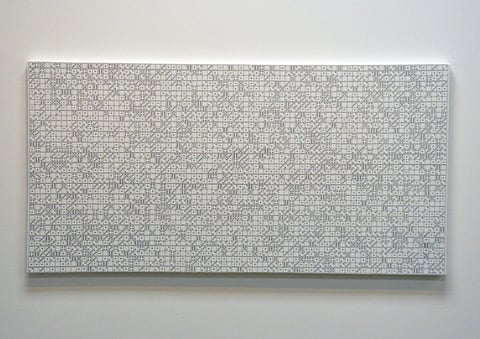
Abdul Aziz has found various interesting ways of creating visual cryptograms that express her thoughts, feelings and experiences in terms of numbers, colours and geometric forms. For instance three large canvases, titled “Sharjah to Dubai”, “Sharjah to Abu Dhabi” and “Sharjah to Umm Al Quwain”, feature grids filled with black dots and empty white spaces. The grids, which look as if they are made up of domino tiles, are actually a documentation of the car number plates she saw on those road journeys.
“I am so obsessed with numbers and equations that when I am on the road the only thing I notice is the number plates of the cars, and I try to find equations by which I can remember the numbers. In fact I reached a point where I was really suffering because I just could not stop myself from memorising the numbers. I felt I needed to heal myself and I used my art to do that. I noted down all the numbers on the number plates I came across during these three journeys, and put them in these grids. But I used domino tiles to represent the numbers. Although the canvases look similar, they are different and each is a visual account of a particular trip. I used the dominoes because they are related to my childhood memories of playing the game with my father and are hence a part of my life’s journey, and of my autobiography,” Abdul Aziz says.
Although there is an emotional angle to these paintings, they also reflect Abdul Aziz’s penchant for playing with numbers. “I like to read the numbers in the grids as the sum of two adjacent domino faces, and I want to stimulate viewers also to imagine different ways of reading the numbers and to do some calculations when they are looking at my paintings. I enjoyed doing this because I love creating something that is systematic, minimal and mysterious. And I avoided using colour in these works because it would distract attention from the system,” she says.
Abdul Aziz is also displaying a set of 150 drawings on paper that are full of vibrant colours, a variety of geometric shapes and numbers. These are actually pages from her diary. With a mischievous smile she says that some of these pages are love letters, some contain dates that are important to her and one features an entire e-mail message that greatly disturbed her. But as is typical of Abdul Aziz, these very personal notes are written in a code that only she can decipher. “I like to write a daily diary, but to make sure that nobody else can read it, I use colours, shapes or numbers to record my thoughts or significant incidents. I use different codes on different pages such as substituting letters or numbers with colours, using specific numbers for certain objects or colours to symbolise people,” she says.
However, these cryptic artworks do tell viewers quite a lot about her state of mind at the time. The colours she has subconsciously chosen reflect her moods, and shapes such as a maze-like arrangement suggest a feeling of being hemmed in. “I like the idea that I am revealing in public something that is so private, yet in such a mysterious manner,” she says. But she claims that she has also learnt a lot about herself through these subconscious doodles in her diary. “Creating these works for this exhibition has been a process of self-discovery and a kind of inner healing. For instance, I found that there were certain shapes, colours and numbers that I hated earlier, but they have now started appearing in my work,” she says.
Abdul Aziz is also displaying a series of installations created from discarded objects she has found on the streets or in the homes of friends. She has cleaned and painted these objects and arranged them in glass cylinders to create a kind of record of her daily journeys. “These pieces talk about the growing consumerism in our society, while at the same time giving a new life and value to objects that have become useless,” she says.
Abdul Aziz’s work is deceptively simple. Yet it challenges viewers visually, emotionally and intellectually. By revealing her own inner struggles and also trying to conceal her emotions behind cold logical systems, the artist provokes viewers to think about their own feelings, behaviour and identity in a society governed by overt and covert systems and structures that are based on both emotion and logic.
Jyoti Kalsi is an arts enthusiast based in Dubai.
“Autobiography 2012” will run at The Third Line, Dubai until January 16.


